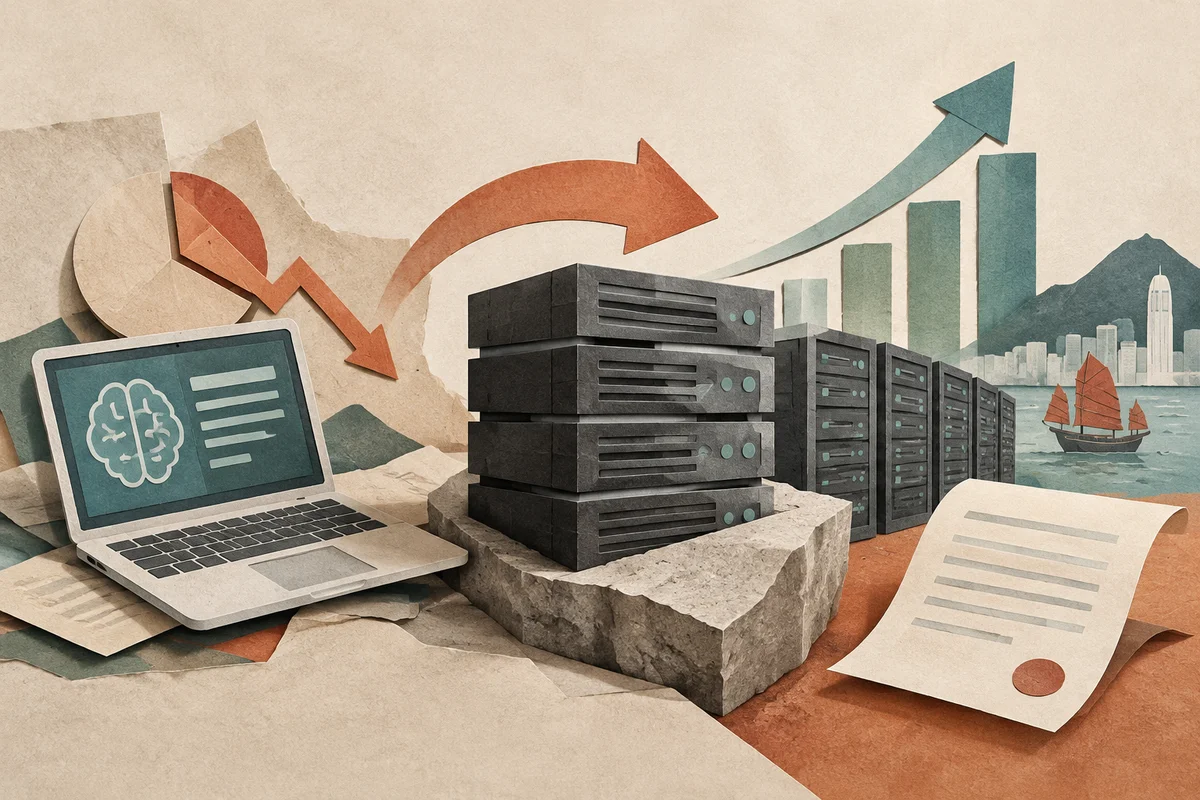
- DataCanvas's AI software services revenue fell from 76.5% of total in 2023 to just 0.1% in the first half of 2026, as the company deliberately abandoned its original business model.
- Total annual revenue grew from RMB 106.2 million in 2023 to RMB 1.10 billion in 2025, a compound annual growth rate of 221.5%, driven entirely by infrastructure solutions.
- Cloud services launched in September 2024 already accounted for 26.1% of revenue in H1 2026, with enterprise customers growing from two to 84.
- The adjusted net loss narrowed from RMB 194.3 million in 2023 to RMB 14.9 million in H1 2026, though profitability remains unproven.
- The Hong Kong IPO filing on September 29 signals that Chinese AI companies are finding capital market paths around compute infrastructure rather than pure software plays.
A Decade-Old AI Company Reinvents Itself
DataCanvas, known in China as 九章云极, filed for a Hong Kong listing on September 29, 2026, presenting public markets with a company whose founding identity no longer describes how it makes money. Established in 2013 as a provider of data science and machine learning software tools, the Beijing-based firm has spent the past three years systematically replacing that business with computing infrastructure delivery and cloud services.
The transformation is unusually complete. AI foundational software services generated 76.5% of DataCanvas's revenue in 2023. By the first half of 2026, their contribution had fallen to 0.1%. Software-service revenue itself contracted from RMB 81.3 million in 2023 to less than RMB 500,000 in the first six months of 2026. This was not merely an old division being overshadowed; it was deliberately wound down.
Infrastructure Becomes the Core Business
The pivot began in early 2023 when large AI models made computing infrastructure a mainstream concern. Customers needed substantial computing resources coordinated across processors, networks, and storage. DataCanvas chose to take responsibility for assembling and delivering that infrastructure rather than continuing to sell standalone software into those environments.
Infrastructure solutions generated RMB 24.9 million in 2023, their first year. By 2025, they brought in just over RMB 1 billion and accounted for 91.2% of total revenue. Total annual revenue climbed from RMB 106.2 million in 2023 to RMB 1.10 billion in 2025, representing a compound annual growth rate of 221.5%.
From Project Delivery to Ongoing Operations
In September 2024, DataCanvas added a second stage to its reinvention by launching cloud services, allowing customers to access computing capacity without arranging entire installations themselves. Cloud-service revenue rose from RMB 196,000 in 2024 to RMB 77.6 million in 2025 and reached RMB 153.8 million in the first half of 2026, supplying 26.1% of revenue alongside the 73.8% from infrastructure solutions.
Enterprise cloud customers increased from two in 2024 to 75 in 2025 and 84 in the first half of 2026. The company also introduced its own computing measurement unit, marketed in China as 'one degree of computing power,' designed to make computing easier to measure and purchase across different resources with charges linked to consumption.
Margins Recover but Profitability Remains Unfinished
Replacing a software business with infrastructure delivery changed what growth costs. Overall gross margin fell from 40.6% in 2023 to 11.7% in 2024 as hardware-heavy infrastructure contracts became dominant. The margin recovered to 17.4% in 2025 and reached 31% in the first half of 2026, reflecting improving economics as cloud services gained scale.
The adjusted net loss narrowed from RMB 194.3 million in 2023 to RMB 91.3 million in 2025 and to RMB 14.9 million in the first half of 2026. The reported first-half loss was substantially larger at RMB 1.09 billion, principally due to RMB 1.07 billion in fair-value changes in financial liabilities rather than operating performance. IPO proceeds are earmarked for research and development, expanding computing resources, developing sales channels, and supporting working capital.
Sources & context
Go to the original material. Company claims remain attributed to their sources.
01