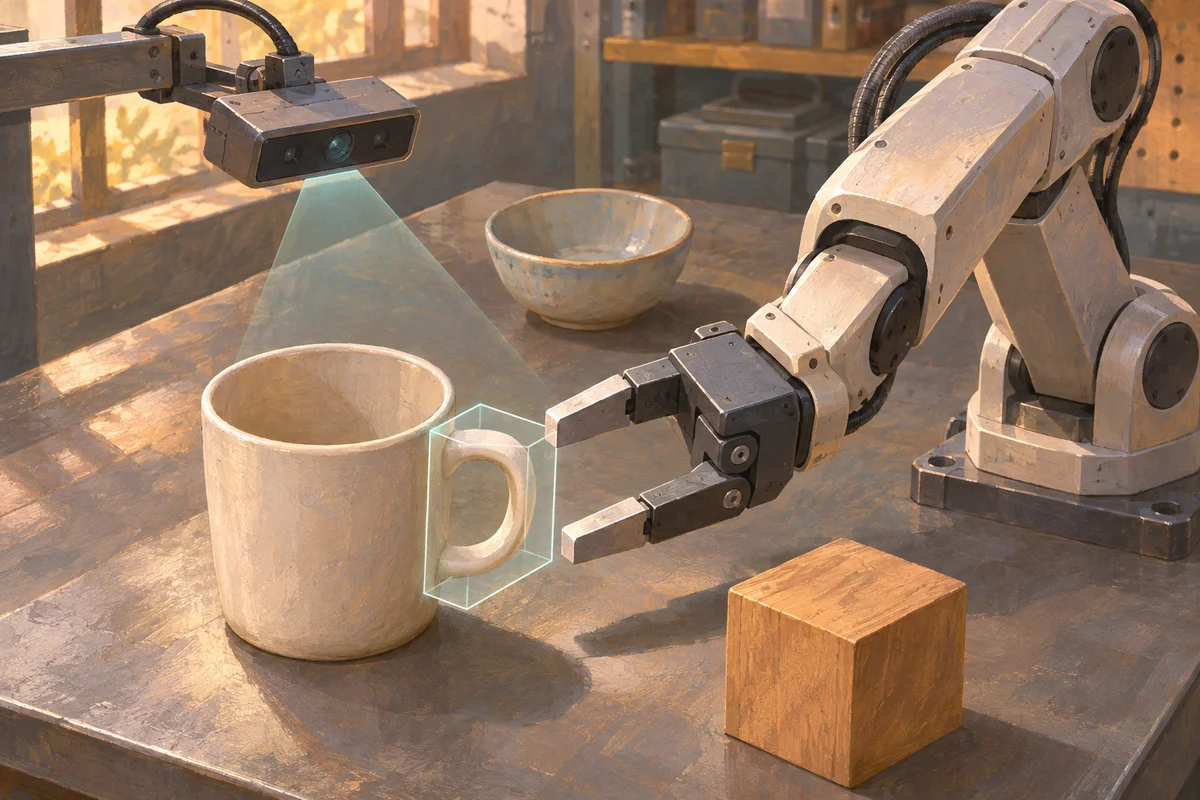
- Training uses perception data without robot joint-action labels, according to the report.
- The reported results concern benchmarks and simulation, rather than verified production deployment.
Perception before actions
XPeng and researchers from Peking University, the University of Hong Kong and other institutions have presented GroundingPI, an embodied-perception research model, IT Home reported on November 4. Its technical account describes a perception-first approach intended to locate objects and their relevant parts before a robot learns what action to take.
The report says training uses perception data without robot joint-action labels, covering 11 capability groups such as detection, referring-object localization, document layout and robot spatial localization. This separates learning where a target is from learning the movements needed to manipulate it.
Prototype results with limits
In the team's reported comparison across 34 perception benchmarks, averaging 11 capability categories equally, GroundingPI scored 73.68 against GPT-6 Astra's 71.54. These are the research team's reported results, not an independently reproduced evaluation by this publication.
The source explicitly describes the work as a research prototype. It also reports simulation experiments concerning demonstration-data efficiency and changed environments. Such tests provide research evidence for the approach, while leaving transfer to new physical settings and production deployment unestablished in this report.
Sources & context
Go to the original material. Company claims remain attributed to their sources.
01