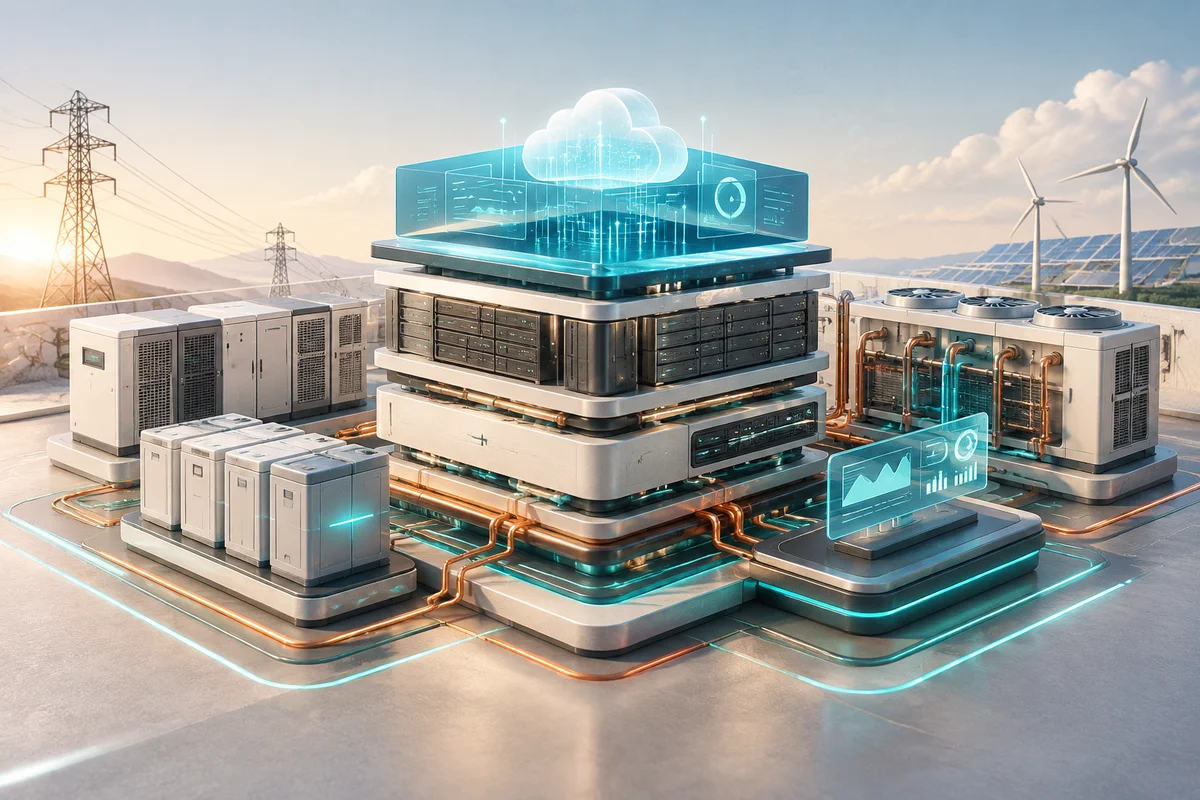
- Huawei's AIDC 1.0 integrates power, storage, cooling and digital operations under a unified source-grid-load-storage architecture for AI data centers.
- New hardware includes the 1280kVA Taishan UPS, multi-voltage Hengshan DC UPS and SmartLi 5.0 storage evolving toward 800V HVDC.
- The TMU thermal management unit is natively integrated with Ascend servers, enabling coordinated power-thermal response to AI workload fluctuations.
- SenseTime disclosed a shift from PUE to Tokens Per Watt (TPW) efficiency metrics, reporting an 80% improvement in token output per unit power cost.
- China's April 2026 policy document explicitly encourages grid-forming storage and green power direct connection for compute facilities.
A Unified Infrastructure Stack for AI Data Centers
Huawei introduced its AIDC 1.0 solution at the AIDC Infrastructure Summit held alongside Huawei Connect 2026 in mid-September. The package bundles power supply, energy storage, liquid cooling and digital operations into what the company calls a source-grid-load-storage architecture, designed to address the growing mismatch between AI compute demand and available power infrastructure.
The announcement follows Huawei's May 2026 AIDC strategy that framed infrastructure reconstruction around three technical pillars - Watt (power), Heat (thermal management) and Bit (digital operations) - plus construction methodology. AIDC 1.0 represents the first product-level realization of that framework.
Power Supply and Storage Hardware
On the power side, Huawei announced the Taishan UPS with a single-cabinet capacity of 1280kVA and up to 98% double-conversion efficiency, targeting higher power density within limited floor space. The Hengshan DC UPS supports 270V, 400V and 800V DC standards on a single hardware platform, allowing operators to accommodate different generations of computing equipment without replacing the entire power distribution system.
The SmartLi 5.0 intelligent lithium storage system enhances energy density, load smoothing and safety capabilities, and is designed to evolve toward 800V high-voltage DC architecture. At the facility level, Huawei's Power Module 5.0 reduces footprint by 40% and cuts delivery time from seven days to three through component innovation and factory pre-integration.
In a deployment at SenseTime's Lingang intelligent computing center, Huawei said the combination of Power Modules and SmartLi containerized storage completed an 18MW power distribution expansion in 45 days, compared with roughly three months for conventional systems.
Thermal Management Integrated with Ascend Servers
The TMU (Thermal Management Unit) serves as the control core of Huawei's AI-enabled liquid cooling system. Beyond coolant delivery, it adds micro-leak detection, coolant health prediction and predictive maintenance. According to Huawei, the TMU is natively integrated with Ascend servers, enabling coordinated power-thermal response that tracks computing load changes in real time.
This joint design approach means server power draw and thermal output information flow directly into the cooling control loop, rather than operating as separate subsystems. Huawei positions this cross-domain integration as a key differentiator enabled by its presence in both the computing and digital energy businesses.
From Adapting to the Grid to Actively Supporting It
Huawei Digital Energy Vice President He Bo described the evolving relationship between AI data centers and the power grid in three stages: from adapting to the grid, to supporting the grid, to actively forming the grid. In the third stage, grid-forming storage and microgrid control technologies enable data centers to provide voltage and frequency support, and potentially operate in island mode when conditions allow.
This vision aligns with China's national policy push. In April 2026, four ministries jointly issued the Action Plan for Promoting Mutual Empowerment Between Artificial Intelligence and Energy (document number 国能发科技〔2026〕34号), which explicitly encourages compute facilities to deploy grid-forming storage and supports green power direct connection for facilities with flexible adjustment capabilities.
Tokens Per Watt as the New Efficiency Metric
Beyond hardware, the summit highlighted a shift in how AI data center efficiency is measured. SenseTime Intelligent Computing Center General Manager Lin Hai announced that SenseTime is moving from PUE-centric energy management toward full-chain efficiency management centered on TPW (Tokens Per Watt). SenseTime disclosed that end-to-end optimization across its infrastructure has achieved an 80% improvement in token output per unit power cost.
Huawei Director and Digital Energy President Hou Jinlong summarized the new competitive logic: more tokens per watt, better cost per token, as the core competitiveness of compute factories. While PUE remains useful for measuring facility overhead, TPW extends evaluation to whether the energy entering servers actually translates into delivered computation.
Sources & context
Go to the original material. Company claims remain attributed to their sources.
01