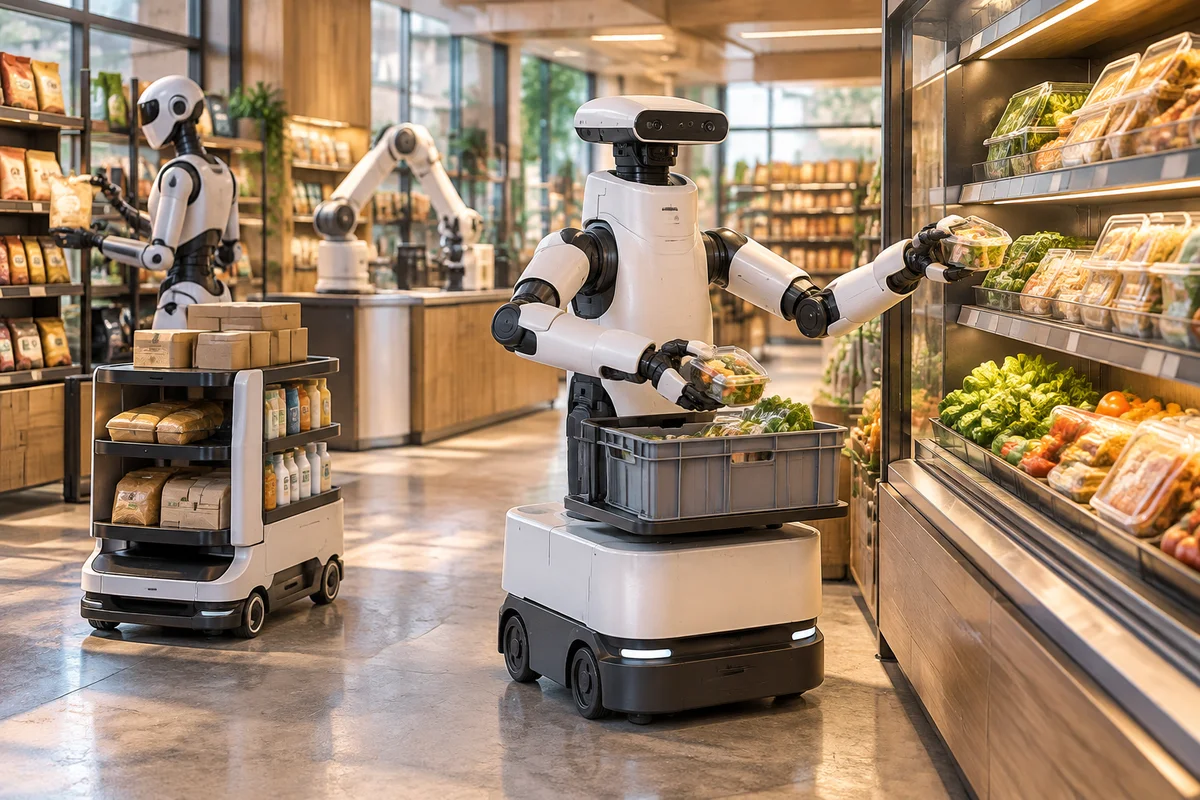
- SenseMart OS links wheeled dual-arm robots, humanoids, grippers and retail equipment into a single deployable system for commercial retail environments.
- Training a new store model has dropped from two-to-three months to roughly one-to-two weeks, with standardized sites operational the day after installation.
- One employee can now support three to five stores, cutting average staffing to about 0.2 to 0.3 workers per location.
- Strong Shanghai locations can break even in six to twelve months; average sites take around a year.
A Platform Layer for Retail Robotics
SenseTime unveiled SenseMart OS at its Shanghai headquarters on September 23, positioning the software as a physical operating system that connects heterogeneous robots, retail equipment and commercial operations into a single deployable package. The system is designed to give operators, brands and venues a replicable embodied-retail solution rather than a one-off demonstration.
Dr. Yi Shuai, co-founder and chief scientist of SenseTime Smart Retail, said the OS focuses on four core capabilities — perception, interaction, decision-making and execution — drawing on years of retail experience including product-recognition systems that process millions of orders daily and a database covering more than 300,000 SKUs.
Deployment Metrics and Unit Economics
SenseMart Go, the robotic store running on the OS, now operates more than 20 locations across Shanghai, Hefei, Shenzhen, Qingdao and Yancheng in settings ranging from campuses and malls to offices and industrial parks. Each store carries roughly 150 to 200 SKUs, about one-third to one-fifth the assortment of a small convenience store.
The robots can run for approximately six hours on a charge and typically need charging twice a day. If a customer arrives while a robot is docked, it can leave the charger to serve them first. One employee can currently support three to five stores, reducing average staffing to about 0.2 to 0.3 workers per location, according to Dr. Yi.
Strong Shanghai locations can reportedly break even in about six to twelve months, while average sites take around a year.
Scaling Through Rapid Skill Learning
A central claim for SenseMart OS is its ability to learn and replicate new skills quickly. The system can acquire one new equipment-handling skill per week at a store and push that capability across existing and future locations. Training a new store model has fallen from two or three months at the first deployment site to about one to two weeks today, and standardized deployments can begin operating the day after installation.
This rapid iteration is intended to address a common bottleneck in embodied intelligence: the gap between laboratory demonstrations and reliable daily operation in unstructured commercial environments.
Ecosystem Partners and Industry Debate
The launch event featured executives from four Chinese robotics companies participating in the SenseMart ecosystem: Zerith Robotics, ACE Robotics, DAX Robotics and Jiutian Yuanshu. Panelists debated where the next wave of value in embodied intelligence will accrue.
Weisheng Xu, co-founder and CEO of Jiutian Yuanshu, argued that getting embodied intelligence into production and daily life matters more than any individual foundation model. Min Yuheng, founder and CEO of Zerith Robotics, emphasized real-world data, saying every time a robot works in a live setting the flywheel of models and data turns once. Dr. Yi pointed to downstream industry data and expertise as the area where the greatest value will concentrate.
Sources & context
Go to the original material. Company claims remain attributed to their sources.
01