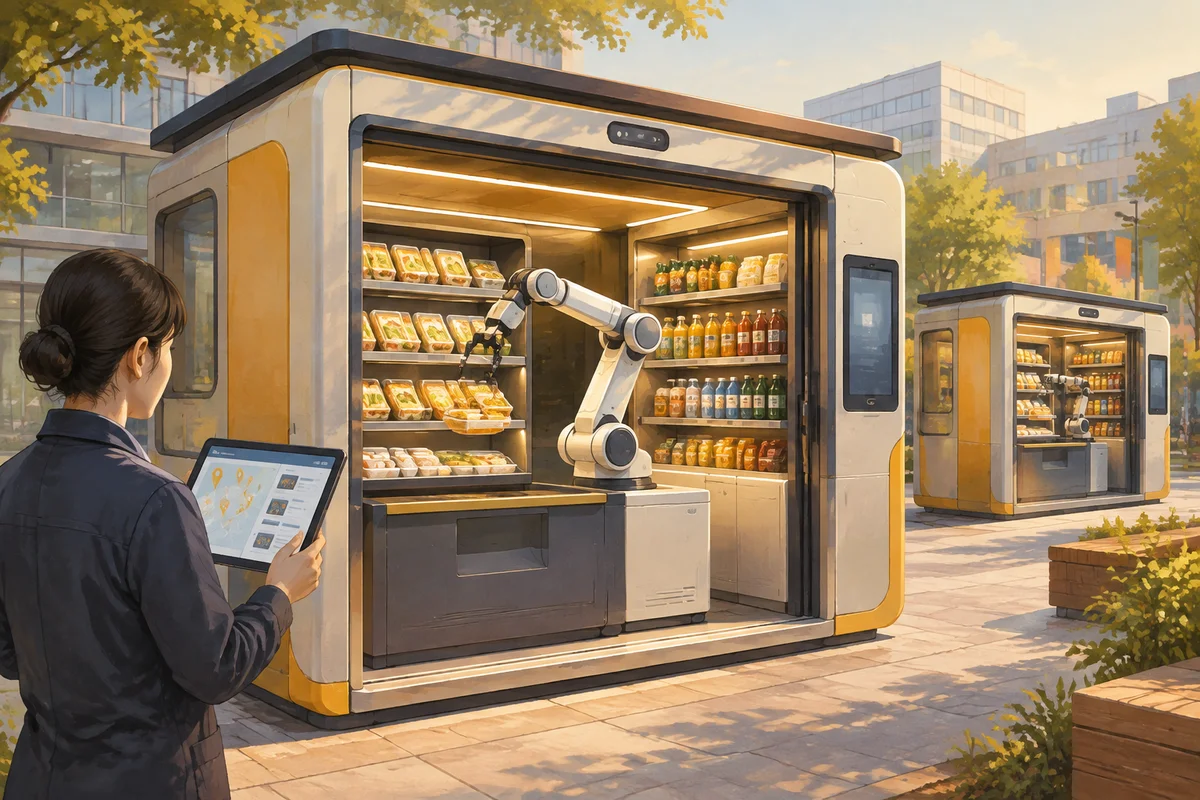
- Shaomai Go robot retail stores have deployed at sites including Shanghai South Bailian Sci-Tech Center and Shanghai Theatre Academy, with over 100 self-operated and partner stores expected by end of 2026.
- SenseMart OS reduces new equipment skill learning to one week per store, enabling rapid replication across locations and scenarios including commercial complexes, university campuses and cultural tourism sites.
- Single-store staffing averages 0.2 to 0.3 people, meaning one person can support three to five stores, compared to roughly two staff per traditional convenience store.
- Opening a second Shaomai Go store near an existing location doubled combined revenue, indicating underserved demand rather than cannibalization.
- Separately, Daxiao Robot has partnered with PetroChina Shanghai to deploy embodied AI robots in gas station convenience stores, with plans to potentially scale to 110,000 stations nationwide.
Robot Retail Moves From Demo to Daily Operations
SenseTime subsidiary Shanhui is expanding its Shaomai Go (SenseMart Go) autonomous robot retail stores across Shanghai, with deployments at Xuhui Riverside, Shanghai South Bailian Sci-Tech Center, Shanghai Theatre Academy campuses and a Taizhou breakfast shop. Co-founder and chief scientist Yi Shuai said the company expects self-operated and partner stores to exceed 100 by the end of 2026.
The stores are powered by SenseMart OS, a retail physical operating system released this week that integrates perception, interaction, decision-making and execution capabilities. Yi said the system can learn a new equipment operation skill in one week at a single store and replicate it across all existing and future locations. Robots currently handle tasks including pouring beer, making sausages, picking up spilled items, recommending products and managing inventory.
Unit Economics and Rapid Deployment
Shanhui reports that single-store staffing averages 0.2 to 0.3 people, allowing one operator to manage three to five stores simultaneously, compared to approximately two full-time staff at a traditional convenience store. The company claims Shaomai Go is the first embodied retail brand in China to achieve a proven single-store profit model, with premium Shanghai locations reaching payback in six months to a year.
Deployment timelines have shortened significantly. When the first store opened in April 2026, tuning a new scenario took two to three months. New school and mall deployments now require only one to two weeks of model adjustment before going live. The system has accumulated visual assets for more than 300,000 products and can complete an order in as little as 15 seconds.
An early test at Xuhui Riverside demonstrated an aggregation effect: after a second store opened within 50 meters of the first, combined revenue doubled rather than splitting existing sales. Yi attributed this to underserved demand in high-traffic areas where robotic service fills a gap.
Expansion Partnerships and Broader Robot Retail Trend
Shanhui announced a 'Thousand Cities, Ten Thousand Stores' initiative with partners including COFCO Zhishang, Ubox, Shengma, Zhiyun, Anlaiye and Gouya. Upstream hardware partners Lingcifang Robot and Daxiao Robot supply robotic bodies for goods retrieval, delivery and order fulfillment within Shaomai Go stores.
The expansion coincides with broader embodied AI deployment in retail. Daxiao Robot separately announced a partnership with PetroChina Shanghai Sales to deploy fully closed-loop embodied AI robots in Kunlun Haokesi convenience stores at gas stations, with potential to scale across PetroChina's 110,000 stations nationwide. Meanwhile, a Qiyuan personal robot experience store opened in trial mode near Huaihai Road, drawing consumer traffic ahead of its official September 29 launch.
Sources & context
Go to the original material. Company claims remain attributed to their sources.
01