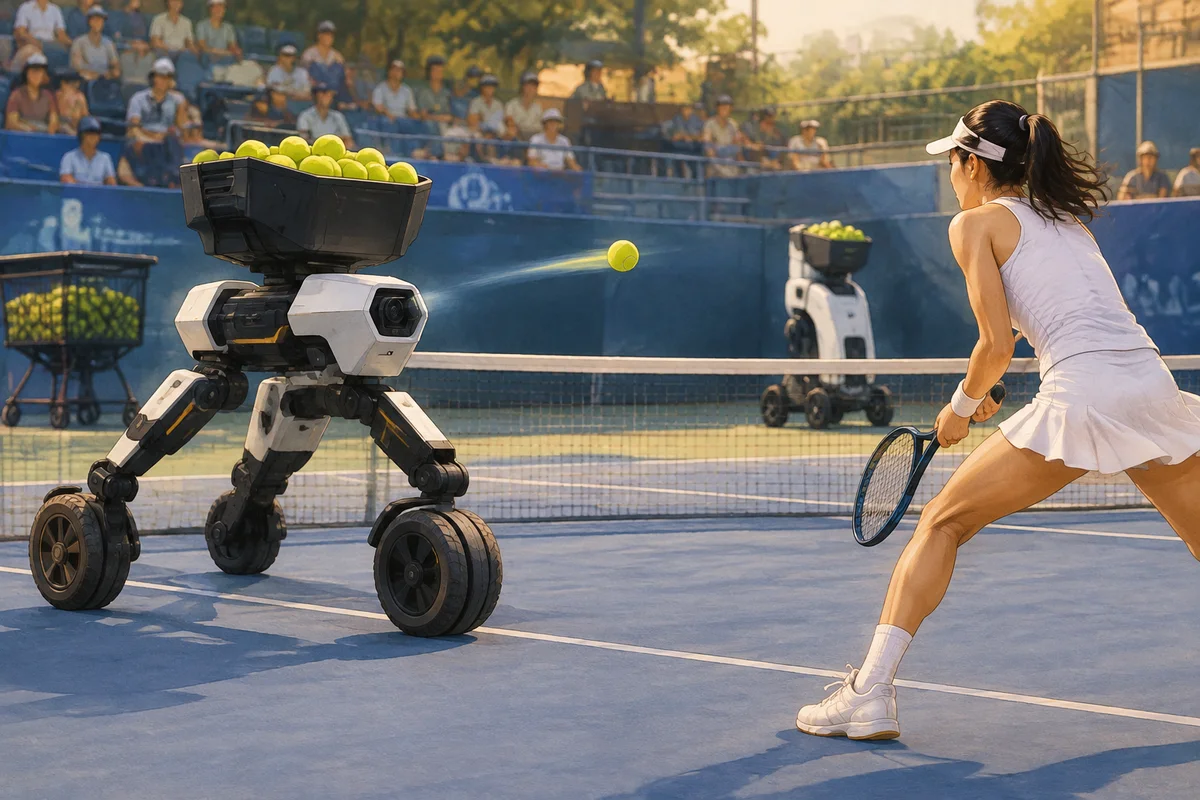
- Tenniix ULTRA MAX, co-developed by LimX Dynamics and Enhanced Robotics, rallied live with tennis player Wang Qiang at the Billie Jean King Cup Finals opening ceremony on September 22.
- The robot uses the TRON 2 wheel-legged platform to adjust its ball-release height, enabling realistic rally play rather than simple ball feeding from ground level.
- Fellow Shenzhen firm Woan Robot signed its Acemate S10 as the first tennis training robot for the China Open in July, demonstrating the city's emerging cluster of consumer sports robotics companies.
- Chinese AI tennis robot makers are pursuing divergent commercialization strategies, ranging from direct sales at under $700 to hourly rental models via shared cabinets at public courts.
Live Human-Robot Rally at the BJK Cup
On September 22, Chinese tennis player Wang Qiang faced an unusual opponent at the opening ceremony of the 2026 Billie Jean King Cup Finals in Shenzhen: a bipedal-wheel robot named Tenniix ULTRA MAX. The robot served first, then responded to Wang's returns by adjusting its stance and delivering topspin shots and moonballs in multi-shot exchanges, according to a report by 21st Century Business Herald published September 25.
The robot was jointly developed by two Shenzhen companies, LimX Dynamics (逐际动力) and Enhanced Robotics (英汉思动力). LimX supplied its TRON 2 wheel-legged mobile platform while Enhanced Robotics contributed the Tenniix Pro AI tennis training system. LimX confirmed in a separate announcement dated September 24 that the platform supports multidirectional movement with a payload of 8 to 15 kilograms and an adjustable ball-release point between 1.2 and 1.6 metres above the ground.
From Ball Machines to Embodied Intelligence
Traditional tennis ball machines typically have fixed release points 20 to 30 centimetres above the ground, producing trajectories that Enhanced Robotics founder Zhu Hanqi described as resembling golf shots. By raising the release point above net height using a legged platform, the ULTRA MAX can deliver offensive and defensive shot patterns that simulate a real opponent, Zhu told 21st Century Business Herald.
The demonstration follows a broader trend of Shenzhen robotics firms entering the tennis market. Woan Robot (卧安机器人), which listed on the Hong Kong Stock Exchange in December 2025, launched its Acemate sub-brand and S10 tennis robot in May 2025. In July, Acemate became the first tennis training robot selected for the China Open, according to the 21st Century report. The industry has dubbed four Chinese companies — Woan Robot, Enhanced Robotics, Chuangyi Technology and Haoyi Xingchen — as the 'four little dragons' of AI tennis robots, with the two Shenzhen firms accounting for half of that group.
Market Opportunity and Commercial Models
The International Tennis Federation reported that global tennis participation exceeded 106 million in 2025, up more than 20 percent from 2021, with China alone accounting for over 25 million players. Meanwhile, coaching supply remains scarce: industry estimates place the player-to-coach ratio in the United States at 800:1, while advanced coaching sessions in China cost between 1,500 and 2,000 yuan per hour, according to practitioners cited in the report.
Enhanced Robotics has pursued a direct-sales strategy, pricing its basic Tenniix model at $699 overseas and around 4,000 yuan domestically. The company said cumulative shipments of its Basic and Pro models have exceeded 20,000 units and projected 2026 revenue of approximately 250 million yuan. Woan Robot has taken a different path, deploying shared rental cabinets at public courts in Shenzhen at rates of 80 to 100 yuan per hour, covering more than 1,100 standard courts across major Chinese cities including Beijing, Shanghai, Guangzhou and Shenzhen.
Both companies indicated plans to layer paid AI coaching services on top of hardware, using accumulated rally data to evolve their products from training equipment into motion-data platforms. Neither has yet disclosed profitability from the tennis segment; Woan Robot reported a net loss of 38.3 million yuan in the first half of 2026 as it scaled marketing spend.
Sources & context
Go to the original material. Company claims remain attributed to their sources.
01