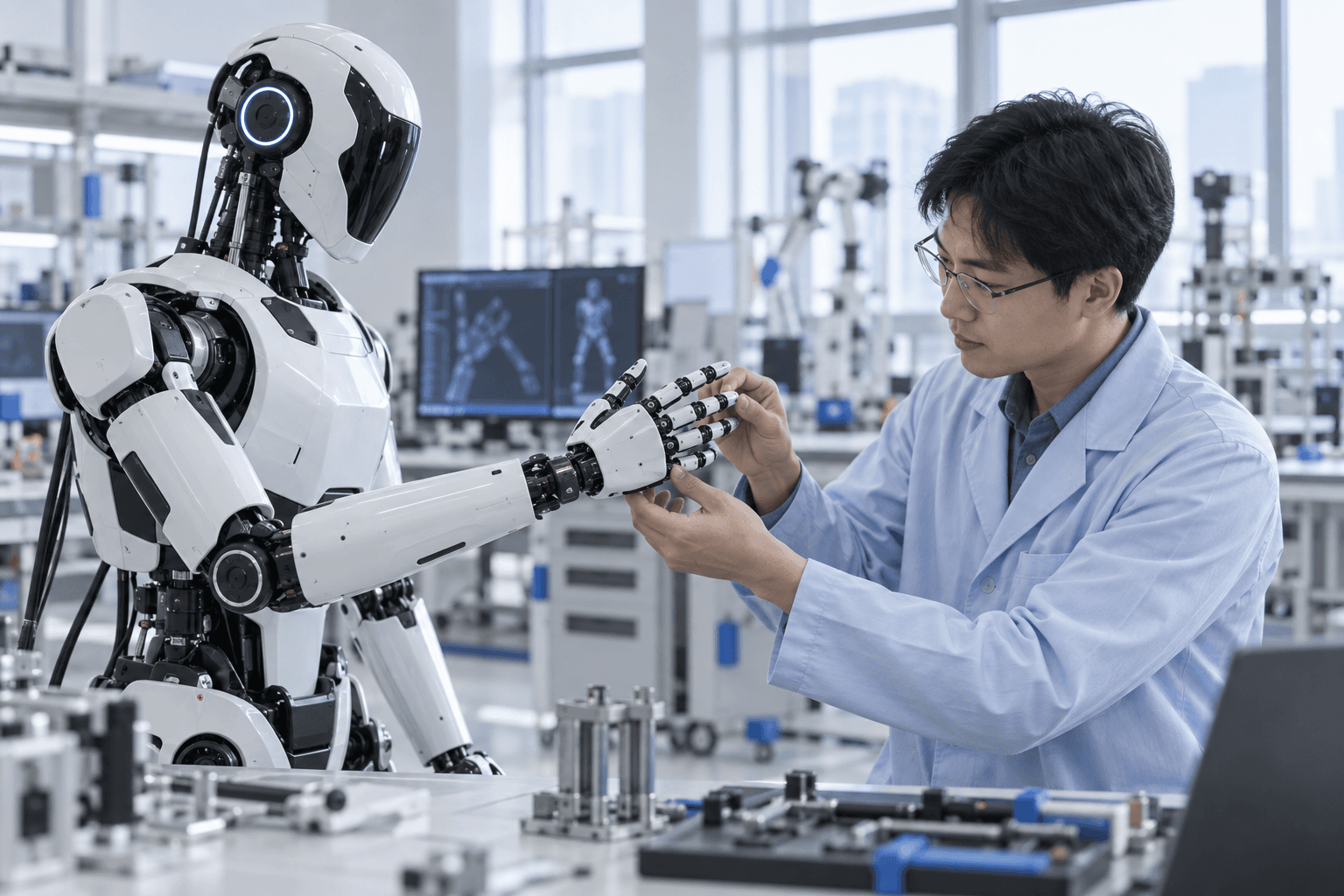
- G1+ adds articulated neck movement, updated actuators, cameras and audio hardware.
- Unitree lists different configurations and development access for standard and EDU models.
- China’s reported RMB 95,000 price and the official overseas $15,000 quote have different tax and shipping contexts.
An upgrade to the G1 platform
Unitree's G1+ refresh adds two neck joints, revised motors and additional sensing and interaction hardware. TechNode reported a standard China price of RMB 95,000. Unitree's English product page lists $15,000 excluding tax and shipping, while EDU configurations require a sales quotation. These figures are regional offers, not directly comparable delivered prices.
The company advertises a 110% increase in peak shoulder and waist motor torque and a 43% increase in peak arm torque. It also describes lower heat generation at matched torque. These are manufacturer comparisons with the preceding design, rather than independently measured gains in completed work.
What the hardware changes are intended to enable
The neck adds controlled head movement, while binocular and wide-angle cameras provide complementary views. Head touch sensing, a six-microphone array and two speakers support interaction. External power is available for extended sessions.
These changes address different constraints. Turning the head can alter what a camera sees without rotating the torso. A broader view can reduce blind areas, and external power can remove one limit on a stationary demonstration. None of those features alone establishes reliable object manipulation or safe autonomous operation near people.
Torque is especially easy to overread. It describes rotational force at a joint, whereas a useful manipulation task depends on reach, posture, balance, gripping and the control policy. A percentage increase in an actuator specification is therefore not a percentage increase in factory productivity.
The standard and EDU offers are different purchases
Unitree's comparison distinguishes the standard and EDU configurations, including their development access and optional hardware. Its published arm payload is configuration-dependent.
That division matters for a research buyer. A demonstration-capable configuration and a platform intended for custom control experiments do not necessarily include the same access, hands or onboard computing. A purchase comparison should start with the exact variant and required software interfaces, then include accessories and support.
Researchers should also ask whether their intended workload needs a dexterous hand, additional computing or a particular sensor stream. An attractive base price may be less informative than the cost of the configuration that can actually run the experiment.
The configuration differences are measurable
The published comparison gives the standard G1+ 25 motorized degrees of freedom and lists 25–45 for EDU, depending on options. Standing height is 1.34 meters, with battery-inclusive weight around 35 kilograms. The table lists arm payloads of approximately three kilograms for standard and four for EDU, subject to posture.
Battery operation is advertised at about two hours. Unitree lists secondary development for EDU, while the standard entry has no such entitlement in the comparison. That is a material purchasing distinction for a laboratory intending to install its own control software. The same table gives eight- and 18-month warranty periods respectively, with detailed terms governed by the warranty brochure.
Availability is separate from demonstrated autonomy
Unitree warns that some showcased functions remain under development and that operating conditions and configurations can change the published parameters. The company also cautions users about the physical power of the machine.
The announcement establishes a revised hardware offering. It does not supply a standard task benchmark, a long-duration reliability result or a comparison of human intervention rates. Those would be useful next measurements for anyone trying to assess the G1+ as a working robot rather than as a collection of upgraded components.
Sources & context
Go to the original material. Company claims remain attributed to their sources.
01Updates & corrections
— Expanded with source reporting, context and a clearer distinction between announced plans and demonstrated results.