- XPeng says its automated IRON assembly line has begun operating.
- The company claims more than 80% automation of core production processes.
- Its roadmap separates scaled production in 2026 from commercial deliveries in 2027.
IRON moves onto an automated assembly line
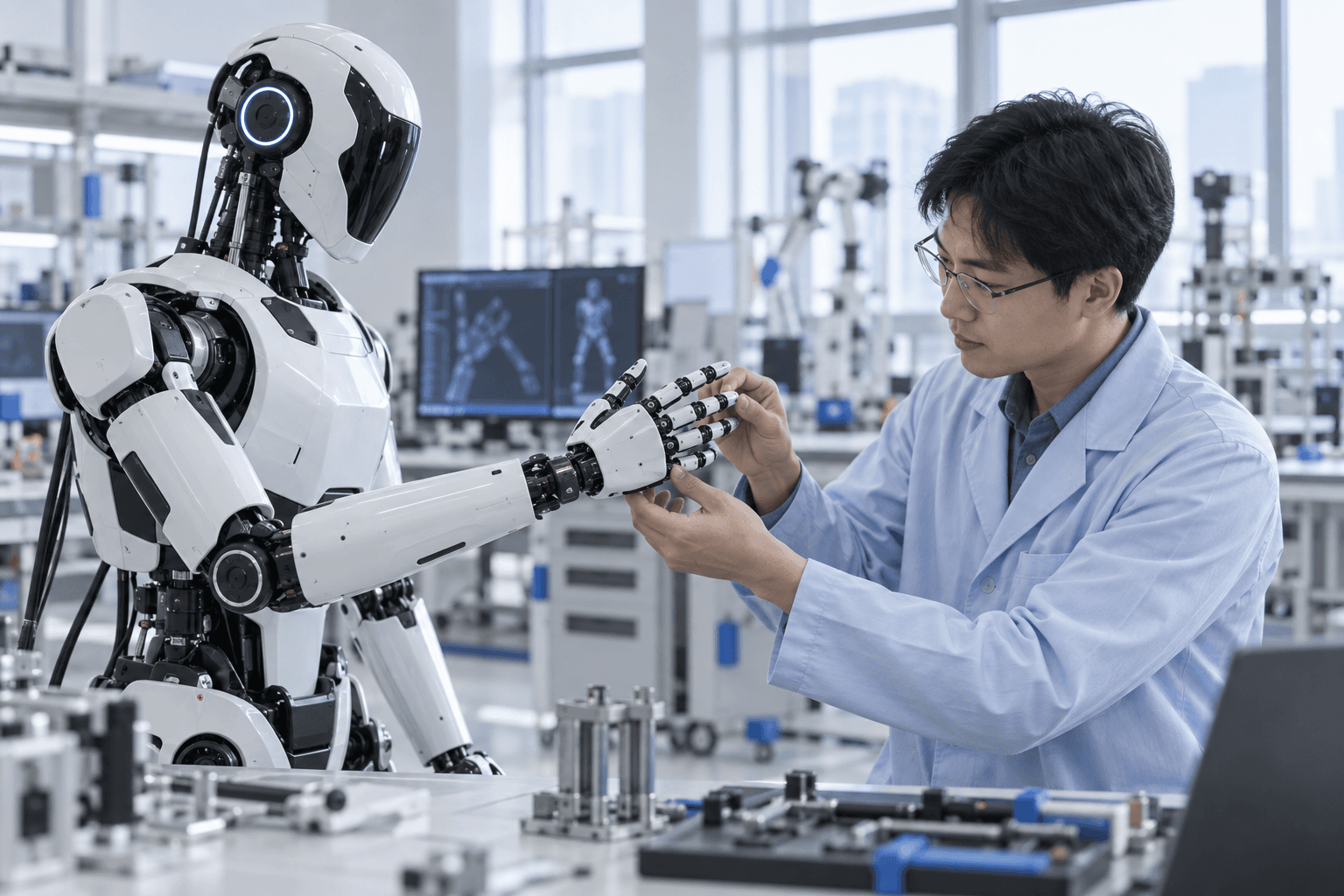
XPeng announced that its humanoid-robot production line had begun operating and that the first IRON unit walked off after automated final assembly. The company says it designed the line internally and automated more than 80% of its core processes.
The milestone concerns manufacturing. It shows the company is attempting to make robot assembly repeatable; it does not establish the volume of machines already delivered to paying customers. XPeng's stated roadmap targets scaled production by the end of 2026 and commercial deliveries in 2027.
Automotive experience meets a different machine
TechNode's report describes the transfer of automotive manufacturing and quality-control practices into humanoid assembly. XPeng says IRON has 76 degrees of freedom and three Turing AI chips with a combined claimed effective computing performance of 2,250 TOPS. These remain company specifications.
A production line can improve consistency by performing the same assembly and checks repeatedly. A humanoid also needs calibration across many moving joints and sensors. Manufacturing repeatability and autonomous task performance are connected, but they are different engineering problems: a consistently built robot can still need further work on its control software.
Assembly and end-of-line testing are distinct stages
XPeng's September 9 announcement describes a line developed around production scale from the outset, using automotive quality practices to improve consistency in critical processes. The company calls the event a transition from research prototypes to line manufacturing. It does not publish an annual nameplate capacity or a completed customer-delivery total in that announcement.
The distinction is relevant to the 2026 schedule. A line can begin commissioning before it reaches its intended output, while initial units are used to refine assembly and quality checks. The company continues to identify year-end as the target for scaled production, with company stores and campuses preceding broader deliveries. Overseas availability therefore remains a 2027 plan in the cited roadmap, rather than an ordering commitment established by the September ceremony.
The capital and commercialization timetable
A separate XPeng investor release described financing agreements exceeding $900 million and initial deployment at company stores and campuses. That gives the manufacturing announcement a funding context and identifies intended early operating environments.
A showroom or campus can provide a defined setting in which to observe customer interaction and day-to-day reliability. It is a different test from unrestricted factory work. The first operating locations should therefore be identified when the company reports deployment, rather than treating every IRON installation as the same use case.
What would demonstrate manufacturing scale
The next useful production figures would be the rate at which units pass final inspection, the number shipped and the cost of rework. An automation percentage does not provide those answers because it counts the process design rather than the output of the factory.
For operating performance, a different set of measurements is needed: completed tasks, interventions, downtime and the conditions under which the robot is allowed to work. An autonomous walk off an assembly line is a visible milestone, but a customer needs a robot to repeat its assigned job over an entire shift.
The combination of new capital and an operating line gives XPeng a route toward that test. It should be assessed against the announced production and delivery schedule as evidence arrives, rather than treated as proof that humanoid deployment economics have already been solved.
Sources & context
Go to the original material. Company claims remain attributed to their sources.
01Updates & corrections
— Expanded with source reporting, context and a clearer distinction between announced plans and demonstrated results.