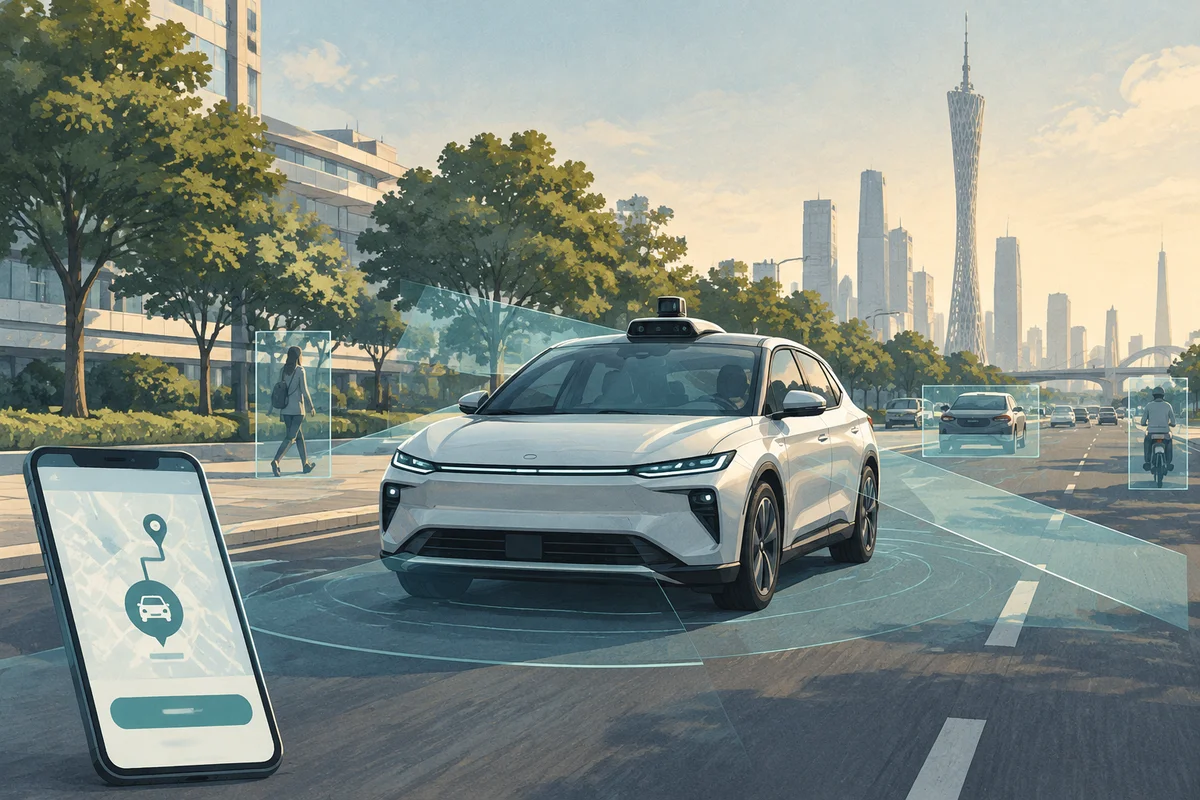
- XPeng formally named its robotaxi business XPENG YOYO and launched an invitation-code-based ride-hailing mini program for public testing in Guangzhou.
- The robotaxi uses four in-house Turing AI chips providing 3,000 TOPS of onboard compute and a second-generation vision-language-action model relying solely on camera-based perception.
- XPeng completed more than 2,000 internal test rides and obtained approval for driverless-seat road tests on designated routes before opening public trials.
- CEO He Xiaopeng stated the company aims to achieve single-vehicle profitability in Guangzhou in the second half of 2027 through high-density operations.
- XPeng plans to introduce a dedicated robotaxi model in 2027 and explore expansion to Shenzhen alongside its Guangzhou base.
From Internal Testing to Public Trials
XPeng has transitioned its autonomous driving program from closed internal validation to limited public access. The company announced XPENG YOYO as the global brand for its robotaxi business and simultaneously released a ride-hailing mini program that allows members of the public to request rides using invitation codes. The service remains restricted in coverage area, booking availability and operating hours during this trial phase.
According to the company, the first production robotaxi — based on its flagship GX model — rolled off the assembly line in May 2026. By July, XPeng had completed an end-to-end service workflow covering online booking, autonomous pickup and passenger drop-off, followed by internal employee testing. By August, the company had logged more than 2,000 internal test rides in Guangzhou and received regulatory approval to conduct road tests without a safety driver occupying the driver's seat on designated roads.
Vision-Only Perception on In-House Silicon
Each YOYO vehicle is equipped with four of XPeng's proprietary Turing AI chips, delivering what the company describes as 3,000 TOPS of effective onboard computing power. The system runs XPeng's second-generation Vision-Language-Action (VLA) model and relies entirely on camera-based perception, eschewing both high-definition maps and LiDAR sensors.
XPeng intends to use a unified technology platform spanning its Level 2 driver-assistance systems and Level 4 autonomous driving capabilities. This approach could allow the company to leverage its existing mass-production experience while reducing the cost and complexity of adapting vehicles to new cities. However, whether a pure-vision architecture can reliably handle complex intersections, temporary roadworks and adverse weather at commercial scale remains unproven and will be tested during the public trial period.
Commercialization Strategy and Profitability Timeline
Rather than directly managing fleet operations, XPeng plans to partner with third-party operators by supplying vehicle platforms, autonomous driving software and full-stack AI capabilities. Revenue is expected to come from vehicle sales, technology licensing fees and a share of ride-hailing order income.
The company plans to introduce a purpose-built robotaxi model in 2027 and gradually broaden its operational footprint within Guangzhou before exploring deployment in other cities, including Shenzhen. CEO He Xiaopeng has publicly set a target of achieving single-vehicle profitability in Guangzhou by the second half of 2027, contingent on reaching sufficiently high order density and vehicle utilization rates.
Industry observers note that demonstrating technical feasibility does not guarantee commercial viability. Vehicle acquisition and maintenance costs, remote supervision infrastructure, safety management overhead, empty-vehicle mileage and insurance expenses all weigh on unit economics. The invitation-based public trials now underway represent the next stage of scrutiny for XPeng's robotaxi ambitions.
Sources & context
Go to the original material. Company claims remain attributed to their sources.
01