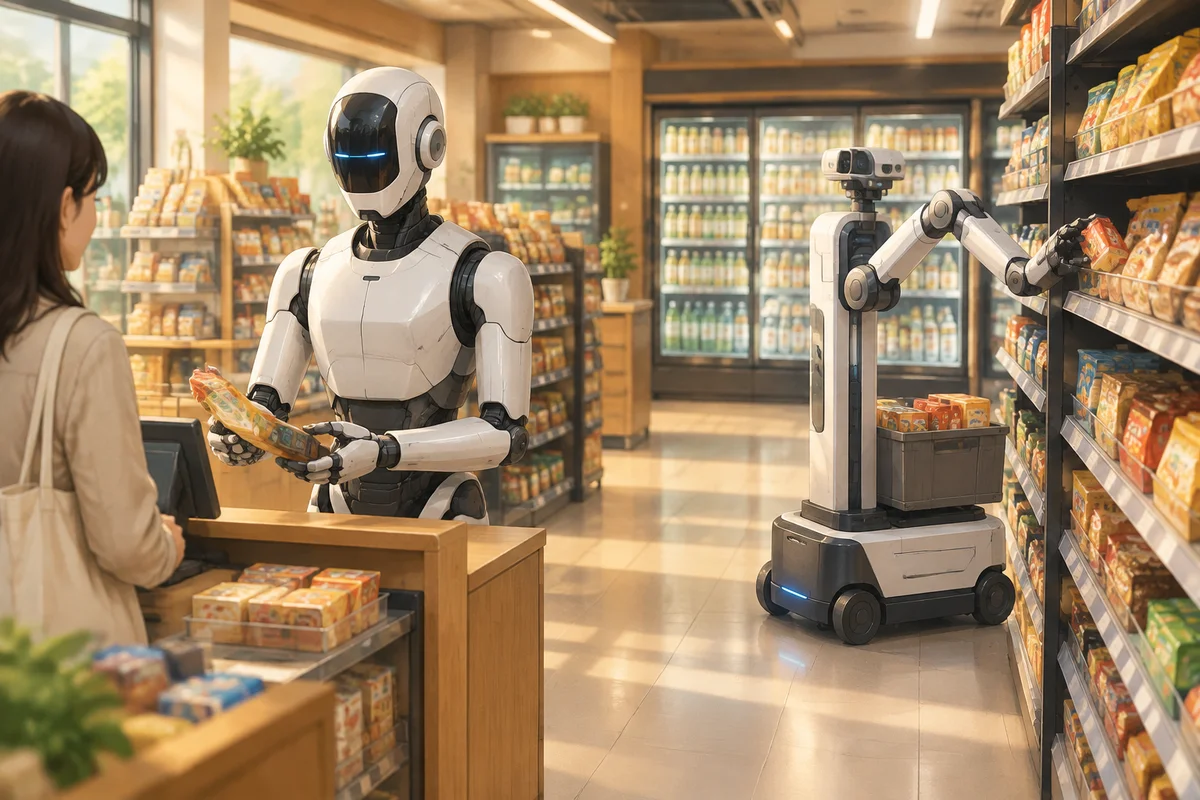
- Zhengxing Innovation released two robot products for retail environments: the H1 bipedal humanoid for customer-facing areas and the C1 wheeled-arm robot for narrow aisle restocking and transport.
- The solution requires no store renovation and targets high-frequency repetitive tasks such as shelf restocking, inventory checks, and overnight operations, with the company claiming 99% autonomous task completion.
- Commercial service is planned for 2027, offered through direct purchase or a Robotics-as-a-Service subscription covering hardware, software, maintenance and upgrades.
- The company's technical stack includes its SLM-0.5 world-action model achieving 98.6% on the LIBERO benchmark and the Rpent agent foundation co-developed with Tsinghua University and Wuwen Xinqiong.
Two Robots for Convenience Store Operations
Zhengxing Innovation unveiled its retail Physical AI solution at the 22nd Asia-Pacific Retailer Conference and Exhibition (APRCE 2026) on October 8, introducing two robot form factors designed for distinct roles within convenience stores. The H1 is a bipedal humanoid robot intended for customer-facing spaces, supporting interaction in more than 20 languages with 45 facial expressions and 36 gestures, along with an open API for secondary development. The C1 is a wheeled-arm robot built for narrow aisles, featuring an omnidirectional chassis that operates without store modifications across a working height range of 100mm to over 1,750mm.
Both robots handle repetitive physical tasks including goods transport, shelf restocking, inventory counting and store inspection, freeing staff to focus on customer service and operational optimization. The C1 uses multi-sensor fusion for pedestrian detection with emergency braking within 10 centimeters, combined with front-rear depth vision and 360-degree panoramic cameras.
Technical Foundation and Commercialization Path
The solution is powered by what the company calls its embodied brain, integrating models, algorithms, data and infrastructure. Its proprietary SLM-0.5 lightweight world-action model achieved a 98.6% average task success rate on the LIBERO benchmark, with inference speed claimed to be 24 times faster than mainstream alternatives. A reinforcement learning post-training system called STEAM reached 95% execution success on designated shelf-stocking tasks, forming a closed loop of execution, feedback, learning and redeployment.
The Rpent agent foundation, developed jointly with Tsinghua University and technology partner Wuwen Xinqiong, combines general large-model planning capabilities with vision-language-action expert models for fine manipulation. An M1 management platform serves as the unified hub for multi-robot task orchestration, monitoring and data review across deployments.
Zhengxing Innovation plans to begin commercial service in 2027, offering the solution through direct purchase or Robotics-as-a-Service subscriptions. The company will partner with global retail chains for joint testing and ROI validation before scaling, with future product expansion including an A1 precision manipulation robot for cashier and bagging tasks.
Sources & context
Go to the original material. Company claims remain attributed to their sources.
01