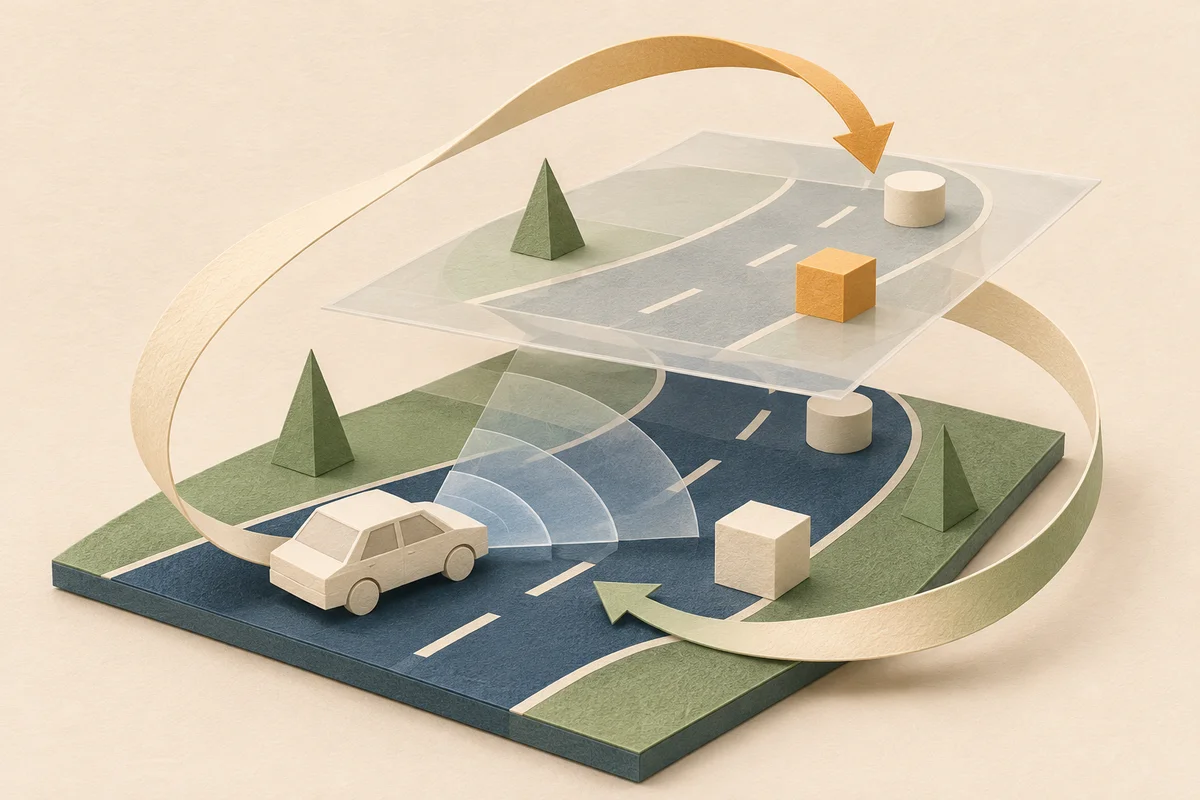
- Baidu describes an agent-driven world model with camera and lidar simulation.
- The announced criteria distinguish causal, interactive simulation from visual realism alone.
An interactive testing loop
Baidu introduced Apollo World, an agent-driven multimodal world model for physical AI, at its Apollo-focused AI Day in Shenzhen on November 3, according to IT Home's same-day report. The system is designed to simulate environments that respond to a driving system's actions, rather than simply generate convincing video.
In the described loop, simulated camera images and lidar point clouds feed the driving system. Its steering, acceleration or braking decisions return to the model, which updates traffic conditions and other agents before producing the next observations. Virtual traffic participants have decision-making and interaction capabilities rather than following fixed scripts.
Criteria and reported use
Baidu proposed two basic requirements, causality and interactivity, plus three advanced measures: physical accuracy, persistence and real-time performance. These criteria ask whether a model respects time, responds to intervention and remains useful over extended simulations.
The report says Apollo World supports continuous trips across virtual cities and is already being used for Apollo Go's international testing and validation. Those descriptions concern Baidu's simulation approach and reported use; they do not establish independently measured safety improvements or prove real-world driving performance.
Sources & context
Go to the original material. Company claims remain attributed to their sources.
01