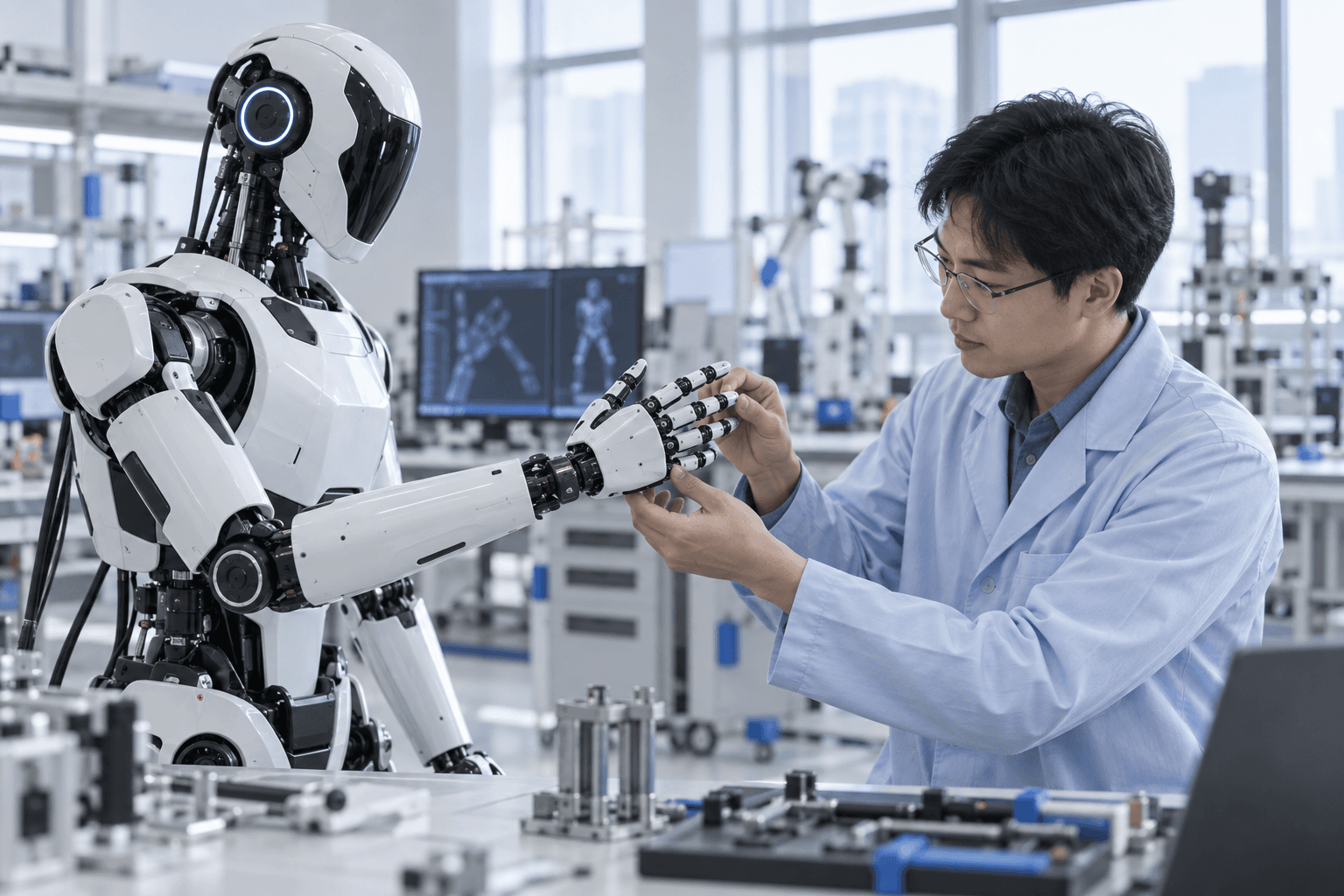
- TechNode reports Unitree’s STAR Market debut under ticker 688836.SH.
- Humanoids accounted for more than half of its reported 2025 revenue.
- The product mix shows a transition from the company’s earlier quadruped base.
The listing arrives after a change in revenue mix
Unitree's Shanghai STAR Market debut brings a fast-growing robot manufacturer into public markets. TechNode reports an offer price of RMB 150.80 per share and approximately RMB 6.1 billion in gross proceeds from about 40.4 million new shares. The ticker is 688836.SH.
The more useful operating detail is the change in product mix. According to the profile, humanoid revenue reached RMB 868 million in 2025, exceeding 51% of company revenue, compared with less than 2% in 2023. The figures describe sales of humanoid products, not the share of machines already performing autonomous industrial work.
Quadrupeds provided an earlier commercial base
Founded in 2016, Unitree first built its business around quadruped robots. TechNode reports RMB 698 million in quadruped revenue for 2025. It puts total company revenue at RMB 1.699 billion and net profit attributable to shareholders at RMB 278 million.
The coexistence of these product lines matters when reading the listing story. The company did not start with a single humanoid prototype and immediately become a public business. Earlier products provided engineering experience and customers, while humanoids changed the growth profile.
The prospectus separates output, shipments and sales
Unitree's prospectus, reproduced by Sina Finance, reports 5,716 humanoids produced in 2025, 5,511 shipped and 5,215 counted as sales. It attributes the shipment-sales gap to units that had left the company but had not completed receipt, acceptance or other revenue-recognition steps by year-end. The three numbers measure different stages.
The same filing lists an average humanoid selling price of RMB 166,400 in 2025, down from RMB 260,400 in 2024. An average across products and configurations is not a retail price for a specific G1. The combination of higher volumes and a lower average price is more informative about the revenue increase than the growth percentage alone.
R&D spending rose to about RMB 145 million in 2025 from RMB 70 million in 2024. Its share of revenue nevertheless fell to 8.53% from 17.83% because revenue grew faster. At year-end, the company listed 184 R&D employees out of 516 total. A falling R&D ratio in this case does not mean that absolute research spending fell.
Hardware sales and autonomous work remain distinct
Revenue is stronger commercial evidence than a demonstration alone, but it does not reveal every customer's use case. Research, education, demonstrations and production work can create demand for different reasons. A robot purchased for development need not already perform an entire job without supervision.
The next operating disclosures worth following are therefore the composition of customers, repeat orders, support costs and the contribution of software or services. Those would help readers understand whether the new revenue base is broadening beyond initial hardware purchases. The IPO provides capital and public scrutiny; it does not settle the technical challenge of making robots useful across unfamiliar tasks.
The revenue-share denominator also matters
The prospectus puts humanoids at 51.78% of main-business revenue, which excludes a small amount of other business. The roughly 51% share of total revenue describes a different denominator. Both show humanoids overtaking quadrupeds in sales value, but neither measures autonomous industrial utilization. The filing provides commercial and research evidence; it does not classify each buyer's robot as a deployed factory worker.
Sources & context
Go to the original material. Company claims remain attributed to their sources.
01Updates & corrections
— Expanded with source reporting, context and a clearer distinction between announced plans and demonstrated results.